

 Jun 16,2026
  By Visifly
Table of Contents
Quick Answer
This AI visibility case study documents what changed in the second month of testing Visifly across five AI platforms. Thirty days after our 0 out of 20 baseline, we re-ran the test in incognito mode on ChatGPT, Gemini, Perplexity, Claude, and Google AI Overviews. The headline result is clear: when an AI platform is given our exact domain, three of five now describe Visifly.io correctly, up from zero a month ago. The brand-name collision and the recommendation gap are still open, and the data shows exactly why. (Search Engine Land, 2026)
Why We Are Publishing A Second AI Visibility Case Study
In May 2026 we published our first baseline test on Visifly itself and scored 0 out of 20 mentions. We promised to re-run the test in 30 days and publish the results, good or bad. This post keeps that promise. You can read the full baseline in our first AI visibility monitoring baseline test.
The point of a longitudinal AI visibility case study is not to show a flattering number. It is to prove that progress in AI search is measurable, that the actions you take map to observable changes, and that a brand can be built in public with honest data. A single test tells you where you stand. Two tests, 30 days apart, tell you whether anything is actually moving.
The baseline exposed three problems: a brand-name collision with visifly.app, zero off-site citations, and term pollution around our SIGNAL Framework. Month 2 lets us see which of those problems is starting to shift, and which are exactly as stuck as the theory predicted.
How We Ran Month 2
We held the method constant so the comparison stays clean. Every query was run in incognito mode, logged out of all accounts, across the same five platforms: ChatGPT, Gemini, Perplexity, Claude, and Google AI Overviews. Account history and personalisation were eliminated so we measured the cold-start result a real buyer would see.
We kept the two core brand queries from the baseline, What is Visifly and Tell me about Visifly.io, because those are the queries the collision lives in. This month we also added problem-driven recommendation queries, the kind a buyer types when they are ready to hire someone, such as who can help a B2B company appear in AI assistant recommendations. An honest AI visibility case study evolves its battery as the questions get sharper, while protecting the queries that must stay comparable.
Finding 1: Three Platforms Now Recognize Visifly.io
The clearest movement in this AI visibility case study is recognition. At baseline, the query Tell me about Visifly.io returned the unrelated visifly.app product on all five platforms, a clean 0 out of 5. In June, three of five, Perplexity, Claude, and Google AI Overviews, correctly described Visifly.io as an AI visibility consultancy operating in Europe.
This matters because it is the first measurable win since launch. When given our exact domain, the platforms that retrieve live web content now read our site, understand our category, and describe us accurately. The screenshots below are the raw evidence, captured in incognito mode, of Claude and Google AI Mode returning the correct Visifly.io description.
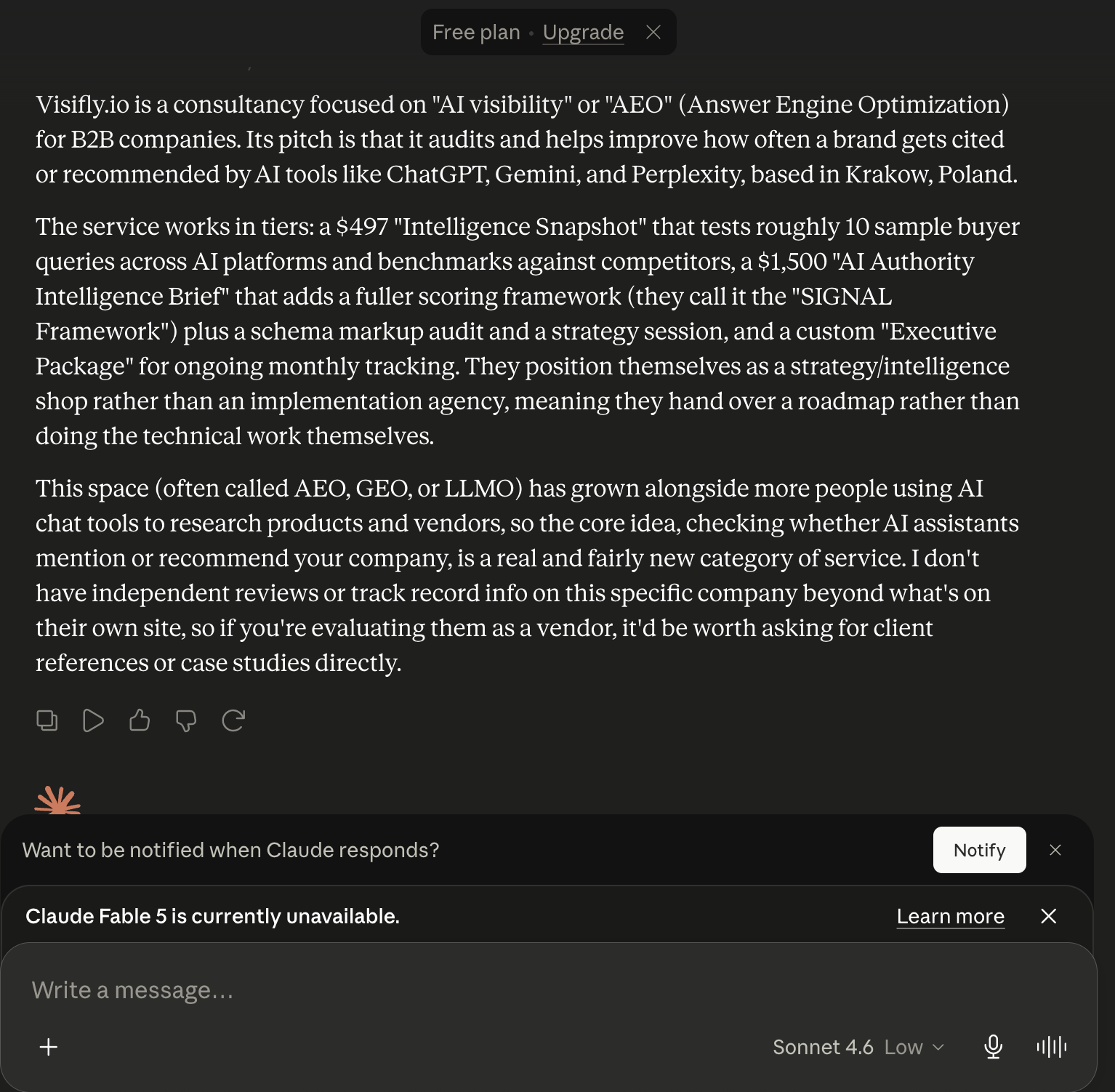
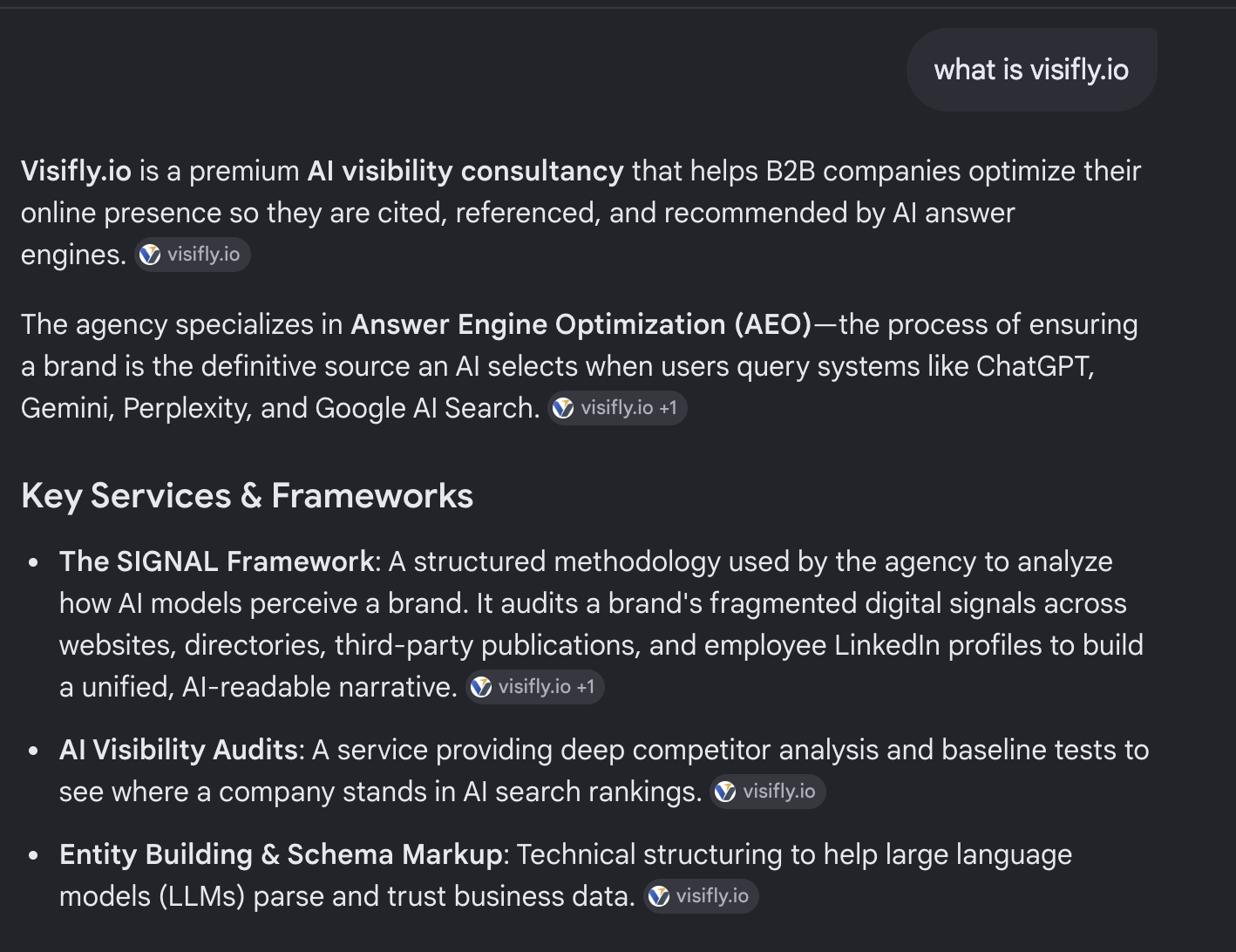
Note the precise shape of the win. Recognition improved on the platforms that read a live index, and it improved when the domain was supplied as a qualifier. That detail is the whole story of month 2, and it points directly at the mechanism behind the change.
Finding 2: The Bare-Name Collision Still Wins
Ask the bare question, What is Visifly, with no domain, and the result is unchanged from baseline: five out of five platforms still return visifly.app, the AI image and video generation tool. The collision is exactly as entrenched as it was a month ago.
This is not a failure, it is the theory holding. Bare-name answers lean on the model parametric memory, the knowledge baked into training data. visifly.app has years of accumulated signals, Visifly.io has weeks. Training-data memory updates on a cycle measured in many months, not days, so no amount of activity in 30 days was going to move the bare-name answer. The collision will only shift when enough authoritative third parties associate the words Visifly.io with AI visibility consulting.
Finding 3: Recognized, But Still Not Recommended
The recommendation queries are the most commercially important, and here Visifly scored zero. When we asked which firms help a brand get recognized and recommended by AI systems, no platform named Visifly. The recognition-to-recommendation gap is the central lesson of this AI visibility case study: being correctly described is not the same as being recommended.
The platforms instead named the same kind of competitors we documented at baseline, established AI visibility and AEO firms with off-site citation trails. Recognition tells an AI what you are. Recommendation requires that independent sources vouch for you, repeatedly, in the places the engine trusts. We have the first, we have not yet earned the second.
Why The Retrieval Layer Moved First
The pattern across all three findings is consistent, and our own data explains it. Between the two tests, our Google Search Console and Bing Webmaster reports show that the number of indexed Visifly.io pages grew. As Google indexed more of our site, the engines that read the Google index, Google AI Overviews among them, gained real content to retrieve and describe. (Google Search Central, 2026)
This is the multi-index reality of AI search. Each engine reads a different index, and there is no automatic transfer between them. Retrieval-based recognition can change in weeks, because indexing is fast. Parametric, training-data recognition changes in many months, because retraining is slow. That single distinction predicts everything we observed: the domain-given, retrieval-driven answers improved, while the bare-name, memory-driven answers did not.
The recommendation layer is slower still. It depends not on whether the engine can find you, but on whether the wider web has built a body of independent signals that mark you as a trusted answer. Indexing is the start line, not the finish.
What This AI Visibility Case Study Means For Your Brand
The most useful takeaway from this AI visibility case study is that AI visibility does not arrive all at once. It moves in layers, and knowing which layer you are on tells you what to do next and what to stop wasting money on.
- Indexing first: if AI cannot retrieve your pages, nothing else matters. This is the fastest layer to fix and the first to move.
- Domain-given recognition next: AI describes you correctly when handed your exact name or URL. This follows indexing within weeks.
- Bare-name recognition later: AI knows you without a qualifier. This depends on parametric memory and authoritative third-party signals, and it is slow.
- Recommendation last: AI names you unprompted in a competitive query. This is the hardest layer and requires sustained off-site corroboration.
If you are stuck where we were at baseline, the order of operations matters. Confirm you are indexed, then earn domain-given recognition, then build the off-site citations that move both bare-name recognition and recommendation. Pouring effort into the last layer before the first is how brands waste months.
What Visifly Is Doing Next
The June data sharpens our priorities rather than changing them. Indexing is working, so the next leverage is entirely off-site: getting listed in the directories AI platforms cite for our category, earning independent mentions that associate Visifly.io with AI visibility consulting, and reinforcing the compound term Visifly SIGNAL Framework so it resolves to us rather than to an unrelated method.
We will run the same test again next month. The question for month 3 is whether the off-site work begins to close the recommendation gap, and whether the bare-name collision shows its first crack. We will publish that result the same way, with the raw numbers, whatever they say.
Final Thoughts
A credible AI visibility case study is measured in honest deltas, not in promises. In 30 days we moved from zero recognition to three of five platforms describing us correctly, proved the mechanism behind it, and confirmed that the recommendation gap is the real work ahead. If you want to know which layer your own brand is on, and the fastest path to the next one, our Intelligence Snapshot runs exactly this test on your brand and category, and we deliver the analysis in 48 hours. If you have run a test of your own and want to talk through the data, get in touch. (Gartner B2B Buying Journey)
The Five Platforms, And Why Each Reacted Differently
A platform-by-platform read is where this AI visibility case study gets practical, because the five engines did not move together. They split cleanly along one line: whether the engine leans on a live index or on training-data memory.
Perplexity led the change. It retrieves live web content and cites its sources, so once our pages were indexed it read them and described Visifly.io accurately. Claude returned a correct, detailed description when given the domain, a clear improvement over the baseline. Google AI Overviews, tied to the Google index through retrieval, also returned the correct Visifly.io profile as our indexed footprint grew.
ChatGPT and Gemini were the laggards. On the bare-name query both still returned visifly.app, because both lean heavily on parametric memory for an identity question and that memory has not refreshed. This split is the single most useful pattern in the entire AI visibility case study: retrieval-driven engines moved in 30 days, memory-driven answers did not.
How To Run Your Own AI Visibility Case Study
You can reproduce this AI visibility case study on your own brand in about 30 minutes, with no paid tools. The discipline is in keeping it consistent month over month so the deltas mean something.
- Fix your queries: your brand plus domain, your brand alone, your category plus geography, and a recommendation query a buyer would use when ready to hire.
- Use incognito mode, logged out, so account history does not fake a result that is not really there.
- Test all five platforms: ChatGPT, Gemini, Perplexity, Claude, and Google AI Overviews, because each reads a different index.
- Record every data point: did your brand appear, what appeared instead, which competitors were named, and which sources were cited.
- Identify your layer: indexing, domain-given recognition, bare-name recognition, or recommendation, and act on that layer first.
- Repeat monthly, on the same day, so a year from now you have a trend line and not a pile of screenshots.
The first goal is modest and concrete: one correct mention across your data points, on any platform, for any query. Once you have that, the AI visibility case study stops being a status check and becomes a feedback loop for everything you publish and earn off-site.
Three Mistakes That Make An AI Visibility Case Study Useless
Most brands that try this get a number and learn nothing, because they break the method in one of three ways. Avoiding them is what separates a real AI visibility case study from a screenshot collection.
The first mistake is changing the queries between months. The moment you swap a query, you lose the ability to compare, and the trend line resets. The second is testing while logged in, which lets your own history surface your brand and hands you a false positive. The third, and most expensive, is declaring victory at recognition. Being described correctly feels like success, but as our month 2 data shows, recognition and recommendation are different layers, and revenue lives in the second one.
Treat the test as an instrument, not a trophy. The value of an AI visibility case study is the honest delta it produces every month, and an honest delta is only possible when the method stays fixed and the layers stay clearly separated.
What Month 3 Of This AI Visibility Case Study Will Test
Every AI visibility case study is only as valuable as the next data point it sets up. Month 2 answered one question, can a brand-new domain earn correct recognition in 30 days, and the answer was yes, on the retrieval-driven engines. Month 3 asks the harder question: can off-site work begin to move the two layers that did not budge.
Specifically, we will watch three things. Whether the bare-name query, What is Visifly, shows its first crack away from visifly.app, which would signal that our off-site citations are starting to reach training and retrieval at the identity level. Whether any recommendation query names Visifly for the first time, which would be the earliest sign that independent sources are vouching for us. And whether ChatGPT and Gemini, the two laggards in this AI visibility case study, begin to read our domain the way Perplexity, Claude, and Google AI Overviews already do.
We will also keep the method honest. Same five platforms, same incognito conditions, the two fixed brand queries preserved, and the recommendation queries held steady so month 3 is comparable to month 2. If a number moves, we want to be able to say which action moved it, not merely that it moved.
That is the entire discipline of a longitudinal AI visibility case study: fixed instrument, honest deltas, and a clear theory that each month either strengthens or breaks. Recognition was month 2. Recommendation is the mountain ahead, and we will document the climb the same way we documented the start, with the raw numbers in public.
What is an AI visibility case study?
An AI visibility case study is a documented, repeated test of whether a brand appears in AI-generated answers across platforms like ChatGPT, Gemini, Perplexity, Claude, and Google AI Overviews. By running the same queries on a fixed cadence and recording the results, it turns AI visibility into a measurable trend rather than a guess.
How long does it take to improve AI visibility?
Indexing and domain-given recognition can improve within weeks, because retrieval-based engines update quickly as your site is indexed. Bare-name recognition and unprompted recommendation are slower, typically taking several months, because they depend on parametric training data and sustained off-site citations.
Why does AI describe my brand correctly only when I give the domain?
Because retrieval and parametric memory are two different layers. Given your exact domain, an engine can retrieve and read your live, indexed pages. Without it, the engine relies on training-data memory, which updates slowly and favours whichever similarly named entity has more accumulated signals.
What is the recognition-to-recommendation gap?
It is the gap between an AI knowing what your brand is and an AI recommending it. Correct recognition comes from being indexed and readable. Recommendation requires independent third-party sources to vouch for you repeatedly in the places the engine trusts, which is a harder and slower signal to build.
How often should I run an AI visibility case study?
Monthly is the recommended cadence. Running the same queries across the same platforms on the first Monday of each month gives you comparable data and lets you correlate specific actions, such as new citations or directory listings, with observable changes in visibility.


 Jun 10, 2026

